Use Of Amount Of Substance In Relation To Masses Of Pure Substances
Overview
Two sacks stand side by side in a farm supply store. They hold the same mass, they cost the same money, and both are sold as nitrogen fertiliser. One of them will put more than twice as much nitrogen into the soil as the other, and nothing on the outside of either sack tells you which. The only way to find out is to read the chemical formula and do about ninety seconds of arithmetic. That arithmetic is what this lesson is about, and it is the single most useful piece of number work in the whole of chemistry.
You will start by learning to add up a formula, turning a string of symbols and subscripts into one number that stands for the mass of the whole unit. From there you will work out what fraction of a compound is the element you actually care about, which is how a farmer chooses between two sacks and how a mining company decides whether an ore is worth digging out of the ground. Then you will take that fraction off the page and put it to work on a real mass, turning a percentage into tonnes of metal or kilograms of nutrient. Three steps, one balance, and no instrument more exotic than a calculator.
Objectives
- The relative formula mass (Mr) of a compound is the sum of the relative atomic masses of the atoms in the numbers shown in the formula. Students are expected to use relative atomic masses in the calculations specified in the subject content. Students should be able to calculate the relative formula mass (Mr) of a compound from its formula.
- The percentage by mass of an element in a compound can be calculated from the relative atomic mass of the element in the formula and the relative formula mass of the compound.
Mind map
This topic is mapped out so you can see how the ideas connect.
Open the mind map in the app
Flashcards
Quick recall practice on the facts this topic is tested on.
Practise these cards in the app
Lesson Note
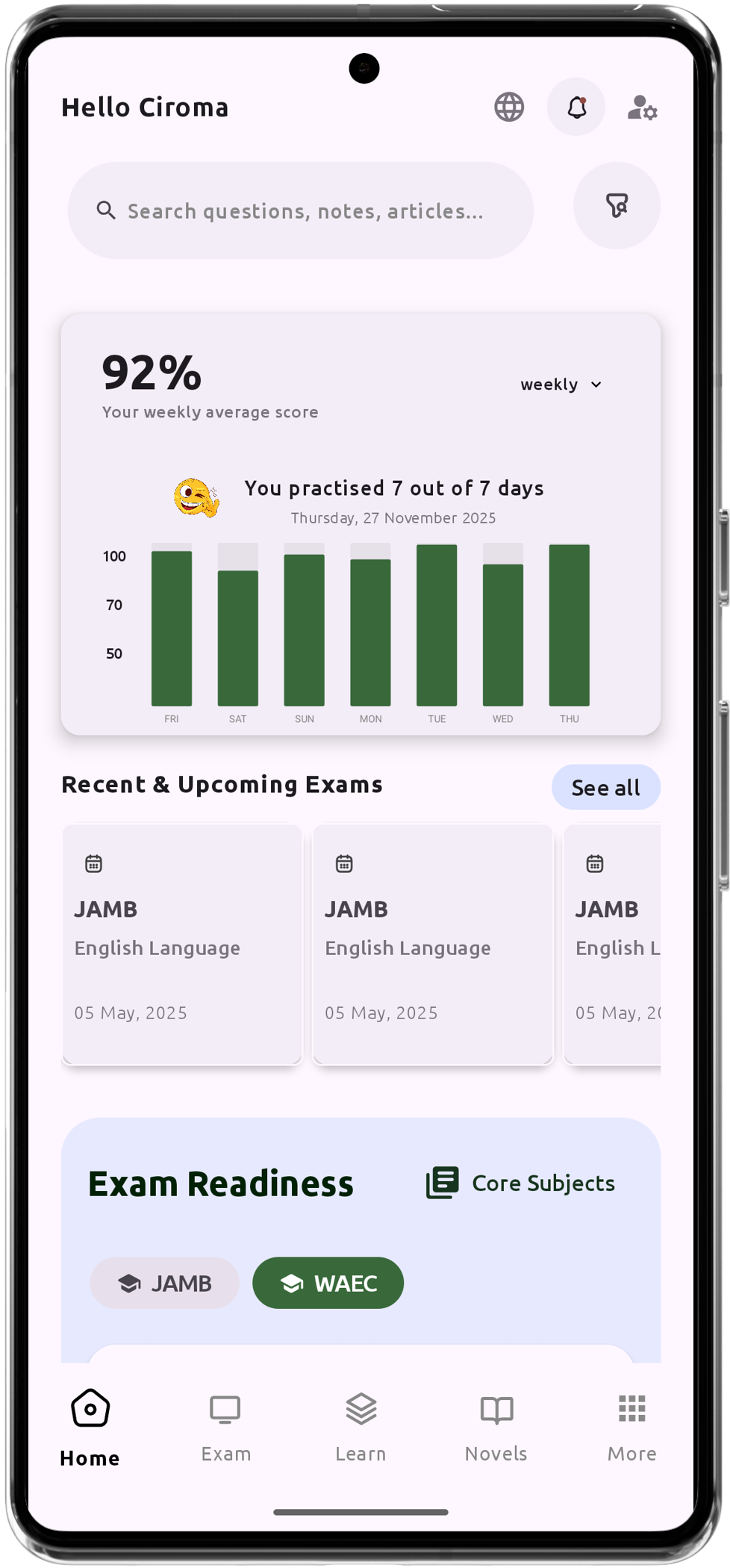
Complete Note Available on the Green Bridge App
Get the Green Bridge CBT app on your phone or computer for the complete IGCSE library: past papers, mark schemes, mind maps, flashcards and audio lessons.
Lesson Evaluation
Congratulations on completing the lesson on Use Of Amount Of Substance In Relation To Masses Of Pure Substances. Now that you've explored the key concepts and ideas, it's time to put your knowledge to the test. This section offers a variety of practice questions designed to reinforce your understanding and help you gauge your grasp of the material.
You will encounter a mix of question types, including multiple-choice questions, short answer questions, and essay questions. Each question is thoughtfully crafted to assess different aspects of your knowledge and critical thinking skills.
Use this evaluation section as an opportunity to reinforce your understanding of the topic and to identify any areas where you may need additional study. Don't be discouraged by any challenges you encounter; instead, view them as opportunities for growth and improvement.
- What is the relative formula mass of calcium carbonate, CaCO3? Relative atomic masses: C = 12, O = 16, Ca = 40. A. 68 B. 88 C. 100 D. 116 Answer: C
- What is the percentage by mass of oxygen in water, H2O? Relative atomic masses: H = 1, O = 16. A. 11.1 B. 16.0 C. 50.0 D. 88.9 Answer: D
- What is the relative formula mass of aluminium sulfate, Al2(SO4)3? Relative atomic masses: O = 16, Al = 27, S = 32. A. 123 B. 150 C. 278 D. 342 Answer: D
- What is the percentage by mass of sulfur in sulfur dioxide, SO2? Relative atomic masses: O = 16, S = 32. A. 20.0 B. 33.3 C. 50.0 D. 66.7 Answer: C
- A farmer spreads 30 kg of urea, CO(NH2)2, on a field. What mass of nitrogen does this supply? Relative atomic masses: H = 1, C = 12, N = 14, O = 16. A. 7.0 kg B. 12.5 kg C. 14.0 kg D. 28.0 kg Answer: C
Work through these questions in the app
Work through these questions in the app
Recommended Books
Further learning from open sources
-
Textbook section
Formula Mass and the Mole Concept
Calculate formula masses for covalent and ionic compounds
"Chemistry: Formula Mass and the Mole Concept" by OpenStax, OpenStax, Rice University, licensed under CC BY 4.0 (https://creativecommons.org/licenses/by/4.0/). Source: https://openstax.org/books/chemistry/pages/3-1-formula-mass-and-the-mole-concept. Access for free at https://openstax.org/books/chemistry/pages/1-introduction
-
Textbook section
Determining Empirical and Molecular Formulas
Compute the percent composition of a compound
"Chemistry: Determining Empirical and Molecular Formulas" by OpenStax, OpenStax, Rice University, licensed under CC BY 4.0 (https://creativecommons.org/licenses/by/4.0/). Source: https://openstax.org/books/chemistry/pages/3-2-determining-empirical-and-molecular-formulas. Access for free at https://openstax.org/books/chemistry/pages/1-introduction
Published by other organisations under open licences, credited as they ask. Links open their websites.
Practice Mock Questions
Want to practice mock questions on Use Of Amount Of Substance In Relation To Masses Of Pure Substances? Download the Green Bridge CBT app to access mock questions and full practice assessments for this topic.
Download The App On Google Playstore
Everything you need to excel in your exams